The Within Heritage Movements project started as a way of testing my artistic boundaries. Learning the story behind the Paracas collection provoked a deep fascination with how diplomatic privilege was wielded in the 1930s. This revelation led me to reflect on my own privilege as a Peruvian artist in Sweden and to explore how I might utilize it as a creative tool within my practice.
I grappled with key questions: How can an artist harness their own role and privilege? Could I turn textile practitioners into “heritage fakers”? If I succeeded, could I leverage my artistic access to reenact a diplomatic smuggle? These initial inquiries became the foundation of my project, evolving into core strategies that informed its sociopolitical relevance.
My journey with the Paracas textiles began in 2008, when I discovered their existence in Sweden, hidden within the Museum of World Culture in Gothenburg. This moment ignited a profound personal connection to these ancient artefacts, intertwining my identity as a Peruvian artist with the complexities of colonial histories and cultural ownership. The knowledge that a collection so significant to our heritage had been illicitly removed stirred a deep urgency within me, prompting my creative practice to engage critically with the narratives surrounding these textiles, leading to the development of two major projects.
Within Heritage Movements invites viewers to consider cultural artefacts not merely as historical objects but as living entities embodying stories, memories, and identities. These textiles were looted from their graves in the Paracas desert in the 1930s and smuggled to Sweden under diplomatic immunity—a journey steeped in a colonial power dynamic that resonates with contemporary discussions about heritage and ownership.
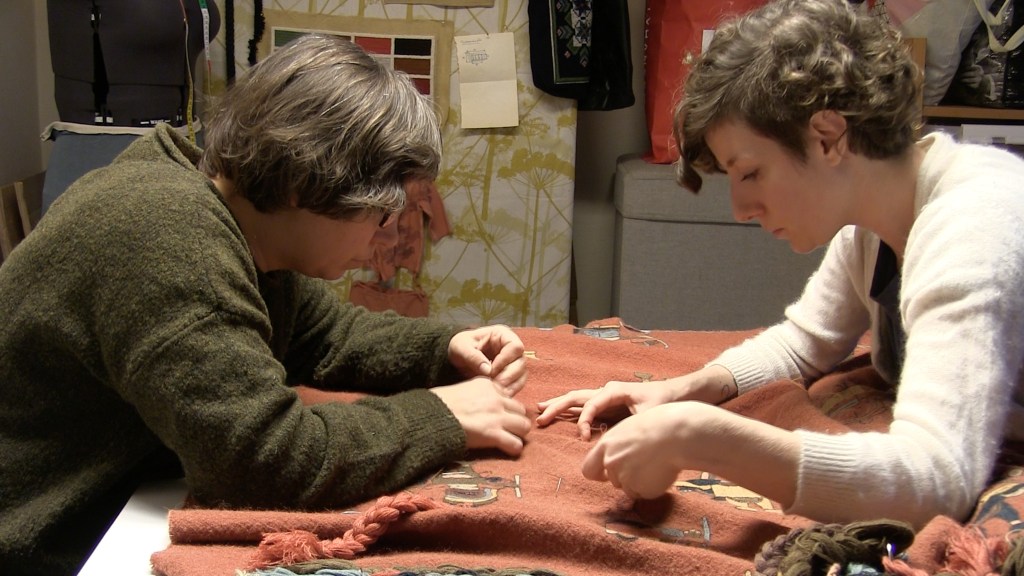
As I immersed myself in the project, I was compelled to replicate two of the original textiles, collaborating closely with Swedish experts to create these replicas using ancient techniques. This act went beyond mere reproduction; it served to invert historical hierarchies by positioning me, a Peruvian artist, as an employer of Swedish labour. However, to instrumentalize this labour effectively, I had to engage in a process of self-instrumentalization, acknowledging the complexities of my context as a dark South American artist in Scandinavia—a position rich with implications, and boundaries, but also with new avenues of access.
This duality prompted me to interrogate the artist’s role within this framework. I sought to explore how that role could evolve from simply representing political issues to actively fostering tangible political change. This inquiry became central to my artistic journey, as I navigated the intricate interplay of power, privilege, and responsibility inherent in the artistic practice.
The meticulous process of weaving and embroidery became a medium for reflecting on and critiquing the colonial structures that have historically shaped the narratives surrounding these artefacts. Within Heritage Movements attempts to transform the perception of these pieces, allowing their materiality to resonate differently depending on the context, audience, and ongoing discourse surrounding cultural heritage. This adaptability underscores the project’s core intention: to provoke critical discussions about the ethics of display and the responsibilities of institutions holding artefacts that do not belong to them.
In this ongoing exploration, I aim to bridge my personal connection to the Paracas textiles with broader societal conversations about identity, heritage, and the implications of colonial histories in contemporary art practices. Within Heritage Movements wishes to stand as a testament to the complexities of cultural exchange, reminding us that the stories of our past are intricately woven into the fabric of our present.
A project in collaboration with: Hanna Adenbäck, embroiderer Martin Ciszuk, research and production advisor Jesús Cossio, ilustrator Elisabeth Hamfelt, embroiderer, material expert Lena Hammarlund, research and production advisor Jenny Larsson, embroiderer Ulrika Mars, embroiderer Maria Nordin, embroiderer Astri Sorby, embroiderer Maiko Tanaka, research and production director Sara Thorn, research and embroiderer
Advisors: Anna Javér, conservator restorer for the Museum of World Culture of Sweden María Ysabel Medina, conservator restorer for the Museo Nacional de Peru
With the contribution of: Sara Arrhenius, former Vice-Chancellor, Royal Institute of Art, Stockholm José Beraún Araníbar, ambassador of Peru in Sweden Sharon Lerner, director of the Museo de Arte de Lima MALI, Lima Natalia Majluf, former director of the Museo de Arte de Lima MALI, Lima Mari Irene Muñiz, cultural officer for the embassy of Pery in Sweden
Produced with support from the Royal Institute of Art in Stockholm, the Museum of World Culture, and Göteborg International Biennial for Contemporary Art (2021).
The alpaca wool was sourced from Hamralpaca and Österlen Alpacka.
 Mining Life